

GoldHaven on launchpad: What Happens When I Pound The Table on a Stock?
$8M+ War Chest, 10,000M Drill Program, and Two Explosive Discovery Shots - Including high grade silver, tungsten, indium, zinc - and gold.
For those who may have missed the May 17th JMP Sunday update, I highlighted a blockbuster 30 days with multiple 150%-200% winners. The catalysts I’ve been waiting for are hitting in succession.
I alerted subscribers to each opportunity, and those who played, won.
I’m back again with GoldHaven - out of pure conviction.
I’ve been covering GoldHaven Resources since February 10th and maintained my high conviction throughout.
The stock has been bouncing between the low 20s and high 30s, establishing a rock solid support base in the low 20s.
Since our last update GoldHaven has transitioned from “waiting to finance, waiting to drill” to “fully financed, two hot drill programs incoming”
Here’s why I have been accumulating this stock on dips.
GoldHaven Resources (TSXV: GOH / OTCQB: GHVNF)
Market cap (~85M shares outstanding, post-$5M financing closing):
$23 million
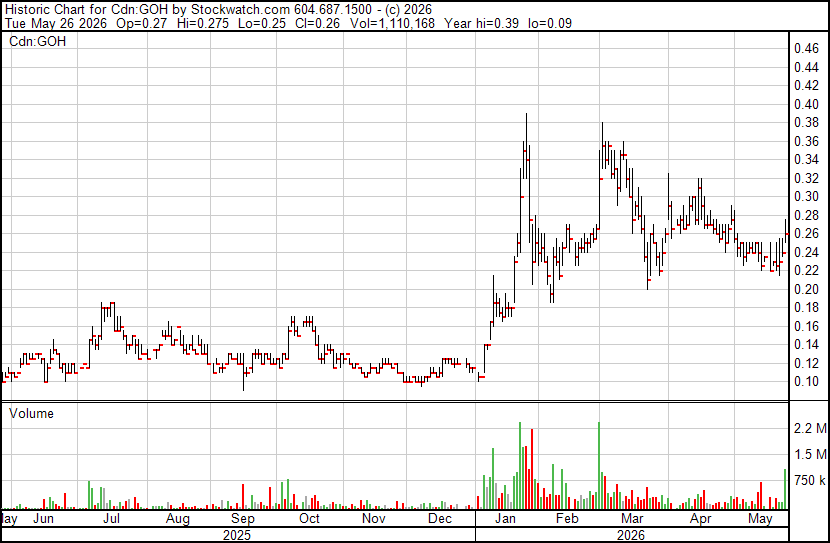
Yesterday, GoldHaven had its highest volume trading day in three months, closing up 8.3% on 1.1 million shares.
$3.26 million flowthrough recently closed, and a pending $5M hard dollar about to close with drill targets defined on two assets ready to show the world what lies beneath.
Smart money has started moving in aggressively.
tl;dr: I have not been this excited about two drill programs under one ticker in a very long time. GoldHaven just closed $3.26M flow-through and is closing a $5M LIFE offering for roughly $8M+ in the treasury. The company just hired Machai Capital for a European marketing push. North American investors are completely unaware of what is about to hit the newswires - GoldHaven is about to let the geology do the shouting from the rooftops.
Magno, BC: district-scale high grade tungsten-indium-silver porphyry in BC Cassiar, never-drilled buried target, first modern program since 1989, drill program expanded to 10,000m.
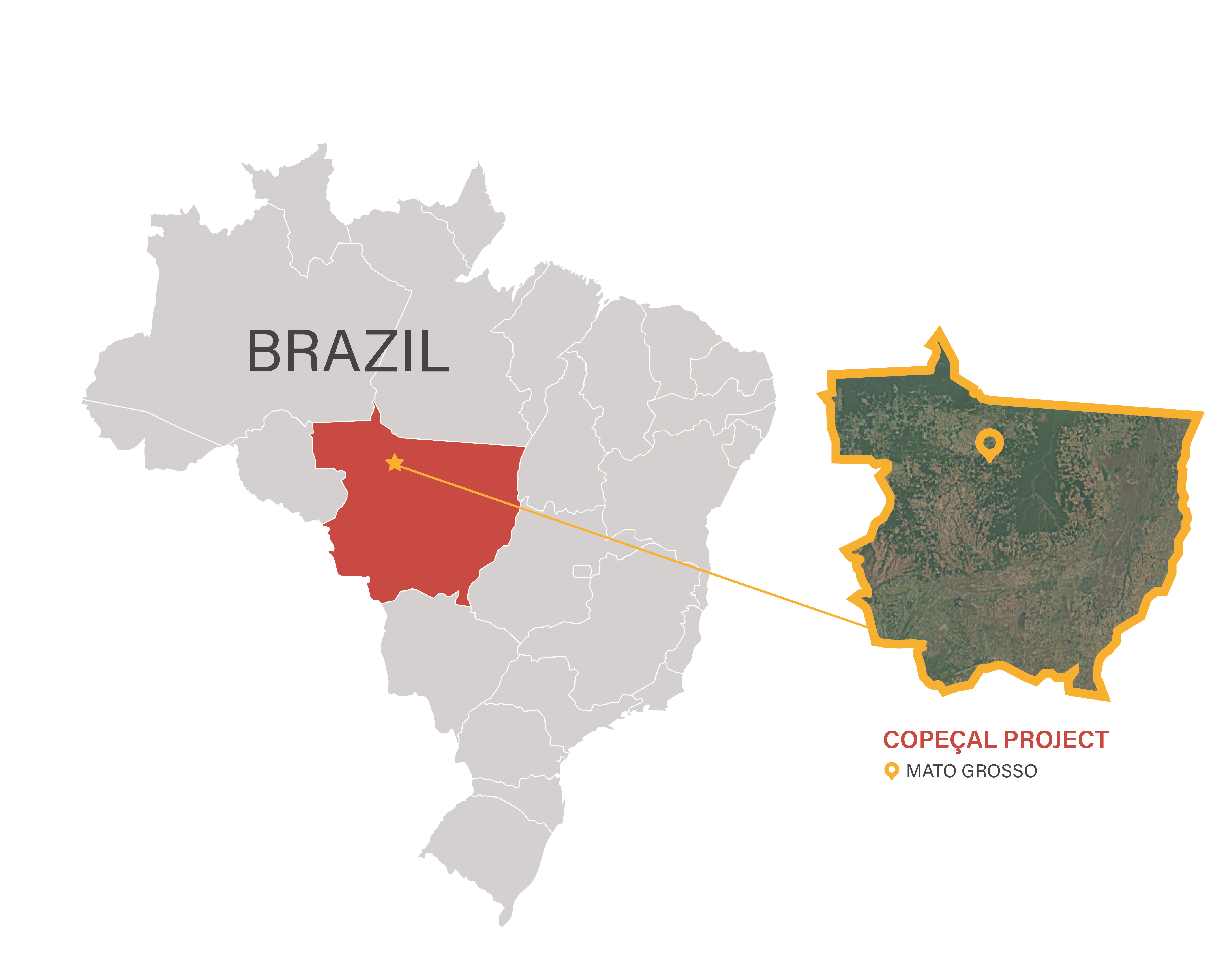
Copecal, Brazil: large-scale hydrothermal gold system in Brazil’s Juruena Gold Province, independent review validated the model, bedrock gold confirmed in maiden drilling,
Phase II starts Q2/Q3. Two discovery shots. Nanocap valuation. Both programs turn THIS quarter. A discovery on either send this stock soaring. This is where fortunes get made.
The Setup: Everything Just Aligned
In over 34 years of investing in this sector I’ve seen thousands of stories and most are noise.
Most retail investors follow noise because they do not have decades of knowledge required to interpret signal.
GoldHaven is signal.
You’re combining $8M cash, two drill programs about to generate newsflow on proven geology in emerging districts, an imminent European marketing push, and a tungsten-indium story that’s federally strategic while most investors are still figuring out how to spell “scheelite.”
CEO Rob Birmingham: “This financing positions GoldHaven to aggressively advance both of our core assets. At Magno, we are now fully funded to execute and expand a significant 2026 drill program across multiple high-priority zones while continuing to build on the strong initial drilling success at Copecal. We believe this dual-track approach provides shareholders with near-term discovery potential and longer-term growth across two highly prospective districts.”
Why I’m More Excited Than I’ve Been in Years
The last three times I pounded my fists, the stocks generated 200% - 300% gains within weeks. KLDC at 0.17, ran to 0.64 within 2 weeks; QGR at 0.13, hit 0.39 in 10 days; Mogote Metals at 0.17, ran to 0.64 within DAYS.
I didn’t get lucky here… I’ve been at this for a very long time and can sniff out an undervalued opportunity.
In my opinion, GoldHaven is one of them.
First: The geology on both assets is textbook exploration-stage setup. Not hopium. Not promotional fluff. Real metal zonation at Magno. Real bedrock gold (this is Critical!) at Copecal. Independent validation on both. The rocks are begging to be drilled.
Second: The tungsten market cooled off in sentiment over the past few months, but the fundamentals are more critical than they were in February. APT prices are holding $2,800-3,190/MTU (+225% YTD). China still controls 80% of supply and slashed exports 40%. The Pentagon is still burning tungsten faster than it can stockpile. BMO still forecasts deficits through 2029 minimum. The U.S. just announced a $12B critical minerals program.
Third: Brazil’s Juruena Gold Province is having a discovery moment and nobody’s paying attention. G-Mining proved 2.0 million ounces at Tocantinzinho. Recent porphyry and epithermal discoveries across the belt are rewriting the playbook. AngloGold Ashanti spent six years defining a 6km gold-in-soil anomaly at Copecal and walked away during a gold bear market. GoldHaven just became the first company to drill it and confirmed bedrock gold in maiden drilling. This story is about to pop.
Fourth: Indium just became the AI photonics bottleneck. Every laser chip in a data center requires indium phosphide substrates. Global demand is 2M pieces against 600K capacity - a 70% deficit. Nvidia dropped $4B in March to secure photonics supply. China controls 70% of indium and export-restricted it. Magno’s 334 ppm indium is 7x typical zinc ore and sitting at surface across a 37,200-hectare district-scale system. If the drills hit what the geology is suggesting, GoldHaven’s Magno instantly lands on Federal and institutional radars across North America.
Fifth: You’re getting two fully funded drill programs on two uniquely hot assets, inside of a nanocap valuation.
This is a “drill bits are about to start turning and you’re either positioned or you’re not” story.
Brazil Gold Rush: Why Copecal Is About to Get Expensive
Let me walk you through why Brazil matters right now.
The Juruena Gold Province (also called the Alta Floresta-Juruena Magmatic Arc) has been producing gold since the late 1970s. But recent discoveries are rewriting the district.
G-Mining’s Tocantinzinho deposit: 2.0 million ounces, 150km from Copecal, mesothermal sheeted quartz vein system. Serabi and Jaca just confirmed porphyry-style gold. X1 and Aura are epithermal discoveries.
The belt hosts multiple deposit styles, which tells you the hydrothermal plumbing is working at every level.
The majors saw it decades ago. AngloGold Ashanti ran systematic work at Copecal from 2010-2016: auger drilling, air-core, geophysics, soil geochemistry. They outlined a 6-kilometre gold-in-soil anomaly and walked away.
Why did they walk? Not because the geology was bad. Because they’re a major and they don’t chase exploration-stage plays in jurisdictions where they don’t have infrastructure. That’s what juniors are for.
GoldHaven picked it up. Completed the first-ever diamond drilling program in Q4 2025.
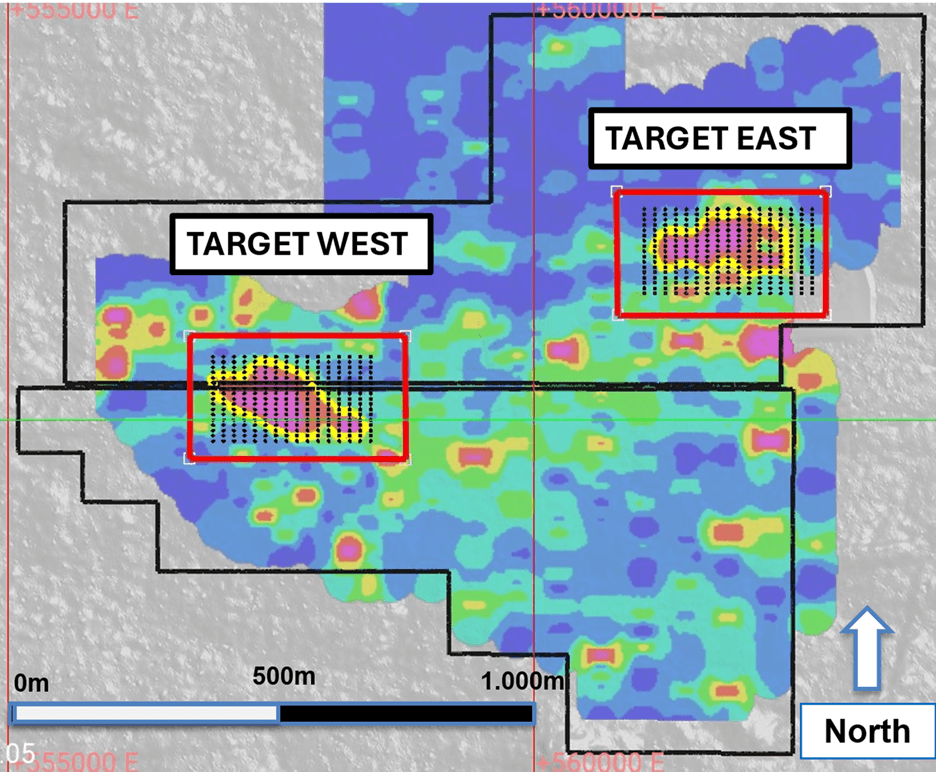
West Target: Gold confirmed in all four holes. Bedrock gold confirmed in unweathered granodiorite-gneiss beneath deep saprolite. Sheeted quartz veining, phyllic alteration, fold-controlled gold enrichment.
East Target: Sulphide mineralization intersected. Chalcopyrite, pyrite, bornite. Approximately 30 metres of sulphides in COPE-PDH-004. Five metres of bornite-chalcopyrite-pyrite in COPE-PDH-009.
Then in May 2026, an independent geological review validated the entire model.
The consultant confirmed: large-scale, structurally controlled hydrothermal system with intrusive-related gold and base metal potential.
Multiple vectors toward stronger mineralization at depth.
Sulphide zonation (chalcopyrite-pyrite transitioning to chalcopyrite-bornite) provides a temperature gradient pointing toward the heat source.
Fold hinge structures at the West Target controlling gold enrichment.
The untested core of the West Target anomaly aligns with a fold closure zone from drone magnetic data.
CEO Rob Birmingham: “This independent review adds important technical validation and strengthens our confidence that Copecal hosts a large-scale mineralized system. Importantly, we are now seeing clear vectors toward stronger mineralization at both the East and West targets, with significant portions of the system still untested.”
Copecal is no longer a surface anomaly backed by AngloGold’s historical data. It’s drill-confirmed bedrock gold with independent geological validation pointing toward a large-scale system.
Brazil is back. The majors and mid-tiers are active across the Juruena belt and Copecal sits in the middle of it with first-mover advantage on a 6km anomaly that’s never been properly tested.
The Geology That Has Me Convinced
Magno (BC Cassiar):
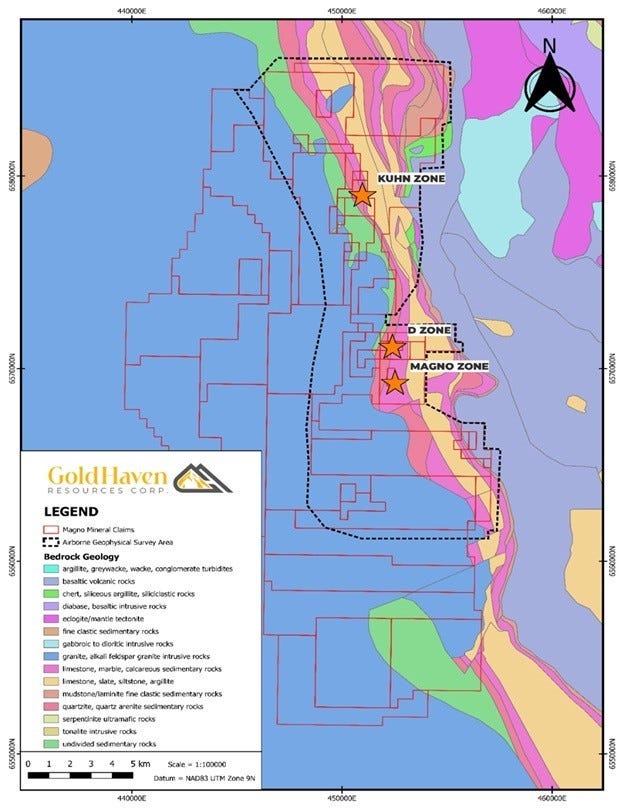
Magno is 37,200 hectares in BC’s Cassiar District. Three kilometres south of the historic Cassiar mining camp. Adjacent to Coeur Mining’s Silvertip mine. Accessible via Highway 37.
This is a district-scale intrusion-related porphyry system with property-wide metal zonation.
Lead-silver carbonate replacement at the property edges. Zinc-tungsten skarns closer to the intrusive center. Copper elevated in the granite itself.
It’s basically a heat engine at depth driving hydrothermal fluids outward in a predictable metallogenic pattern.
I like predictable when investing in rocks.
The buried porphyry copper-moly source, the actual engine, has never been drill-tested.
Shell Canada drilled Kuhn in the 1980s and confirmed tungsten mineralization (scheelite) at depth. They validated the system, then walked away.
Nobody’s touched it with modern geophysics, 3D modeling, or integrated targeting since 1989.
Surface geochemistry: tungsten to 6,550 ppm. Indium to 334 ppm (highest ever recorded at Cassiar, 7x typical zinc ore, 2.4x world-class production grades). Silver grab samples to 2,370 g/t with 20% lead and 19.25% zinc.
The 2026 program integrates everything Shell never had: drone magnetics, 3D metal zonation modeling, structural interpretation, and an airborne mag survey (1,741 line-km, Dias Airborne QMAGT platform—same tech Hercules Metals used for their Leviathan discovery).
The targets are the Magno/D-Zone high-grade silver-lead-zinc CRD system, the Kuhn/Dead Goat tungsten skarns where Shell confirmed scheelite, and the never-drilled buried porphyry copper-moly source that’s driving the entire hydrothermal column.
10,000 metres. First holes this quarter.
Here’s what happens next.
Magno: Airborne mag survey in June. Drill mobilization Q2/Q3. First holes into Magno/D-Zone, Kuhn tungsten skarns, and the buried porphyry target. 10,000 metres across multiple high-priority zones. Assay turnaround typically 6-8 weeks for base/precious metals, longer for tungsten and indium depending on lab capacity.
Copecal: Phase II drilling starts Q2/Q3. Approximately 1,200 metres. Five to six holes targeting fold hinge structures at the West Target and sulphide zonation vectors at the East Target. Assay turnaround 6-8 weeks.
Marketing: Machai Capital launching European awareness campaign. Research Capital as exclusive finder on the $5M LIFE offering, which puts them in distribution mode with institutional relationships.
You’re looking at two drill programs generating newsflow simultaneously across the summer and fall. Every hole at Magno tests a different target: tungsten skarns, CRD silver-zinc, buried porphyry copper. Every hole at Copecal vectors toward the core of a 6km gold system.
What’s Next: Dual Catalysts, Same Company
Magno: Airborne mag survey in June. Drills turn later Q2/Q3 2026 across Magno/D-Zone CRD targets, Kuhn/Dead Goat tungsten skarns, and the buried porphyry copper-moly target. 10,000-metre program fully funded.
Copecal: Phase II drilling (~1,200m) starts Q2/Q3 2026. High-priority fold hinge targets at West Target. Depth and strike extensions at East Target sulphide zone.
Two discovery shots. Two districts. Same $13.4M market cap.
If Magno hits high-grade tungsten-indium-silver mineralization tied to a large porphyry source, this becomes a federally strategic asset overnight. If Copecal vectors into the core of a multi-million-ounce Juruena gold system, the Brazil comp universe reprices it immediately.
IMPORTANT DISCLAIMER AND RISK DISCLOSURE
This analysis is provided for informational and educational purposes only and does not constitute investment advice, financial advice, trading advice, or a recommendation to buy, sell, or hold any securities. The author is not a licensed financial advisor, investment advisor, broker-dealer, or registered investment advisor and does not provide personalized investment advice or recommendations tailored to any individual’s financial situation.
All information presented is the author’s opinion based on publicly available information and should not be relied upon as the sole basis for any investment decision. Readers should conduct their own due diligence, research, and analysis before making any investment decisions and should consult with qualified, licensed financial professionals before investing.
Junior mining and exploration stocks carry substantial risks, including but not limited to: potential total loss of investment, extreme price volatility, liquidity risk, operational risks, regulatory changes, commodity price fluctuations, exploration failures, and dilution from future financings. These investments are speculative in nature and may not be suitable for all investors.
The author may hold positions in securities mentioned and may buy or sell such positions at any time without notice. Past performance does not guarantee future results.
Forward-looking statements and projections are inherently uncertain and subject to numerous risks and uncertainties. Actual results may differ materially from any projections or expectations expressed herein.
This content is not intended for distribution to, or use by, any person in any jurisdiction where such distribution or use would be contrary to local law or regulation. By reading this analysis, you acknowledge that you understand and accept these risks and limitations.