

$20 Million Microcap To Drill First Deep Hole Into a 500-950 Million Tonne Potash Target. Rig Mobilizing Now.
KCLI is punching its first confirmation hole into one of the largest undeveloped potash-lithium targets in the United States. Here’s why the odds of success are unusually high.
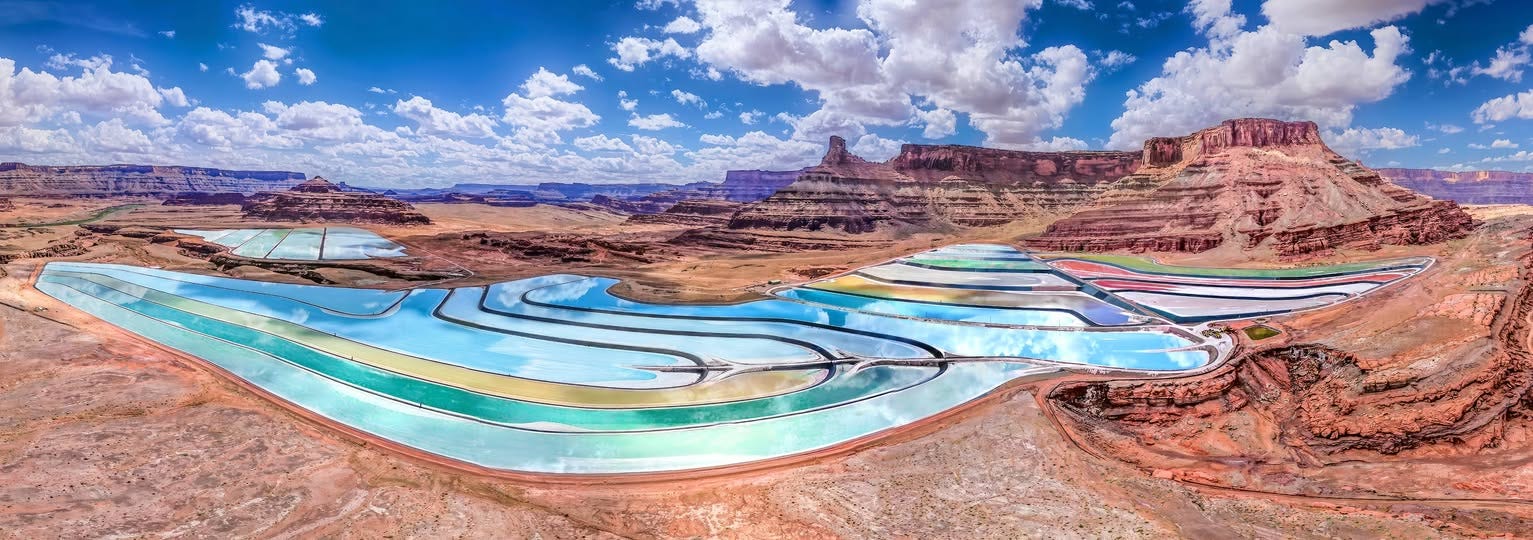
tl;dr: Our core portfolio holding American Critical Minerals (CSE: KCLI / OTCQB: APCOF) announced today that its drill rig is mobilizing to the Green River Project in Utah’s Paradox Basin. A drill program over 10 years in the making, delayed primarily by former permitting regimes. Permits in hand, and a newly assembled senior management team in place is now executing. The Duma Point AP-S-02 well will core through potash horizons and sample lithium-bromine brines at depth. It sits 2,000 feet from a historic well that logged 24.3% KCl potash over 5.9 metres. The company has a $20M market cap and is targeting 500-950 million tonnes of potash plus up to 1.7 million tonnes of lithium carbonate equivalent. Approximately 35 days to well completion.
The backstory in brief:
American Critical Minerals has been assembling this land position for over a decade.
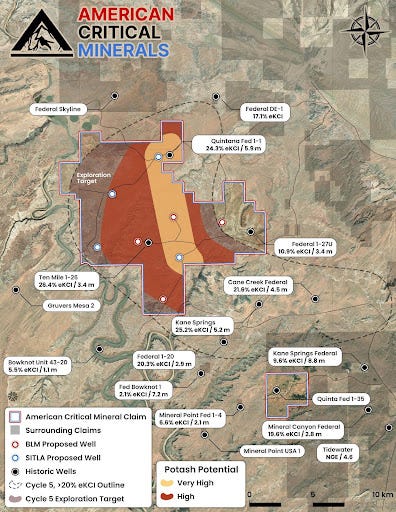
The project covers approximately 32,530 acres across 11 SITLA mineral leases, 1,094 federal lithium brine claims, and 11 federal potash prospecting permits. All 100% owned.
The company is authorized to drill 7 wells across the property.
Permitting was the long game. BLM approval for the Plan of Operations came in October 2024. Final bonding was confirmed in May 2026.
Drill site prep, casing purchase, and subcontractor selection have all been completed. The company engaged RESPEC to execute the drill program and J.A. Drake Well Service to provide the rig.
This is the first confirmation hole ever drilled on the property.
Why the odds of confirmation are unusually high:
This is not a greenfield wildcat.
The Paradox Basin has been drilled extensively by the oil and gas industry for decades.
KCLI’s 43-101 exploration target is built on downhole electric log data from 33 historic wells on or within 8 km of the property. That database gives the geology team a level of subsurface confidence that most first-time drillers simply don’t have.
The Duma Point well is positioned 2,000 feet from the historic Quintana Fed 1-1, an oil and gas well that intercepted thick potash zones within Cycle 5 of the Paradox Formation.
Downhole logs measured 24.3% KCl over 5.9 metres. That same potash cycle has been mined commercially for over 50 years at the nearby Intrepid Potash Moab Solution Mine, America’s only domestic potash producer.
Historic 2D seismic data shows the well location sits within a flat-lying portion of the regional anti-form, a structural setting that favours solution mining.
The seismic also indicates that the deeper brine-bearing Leadville Formation and Paradox clastic zones dip to the northeast with structural lows favouring brine accumulation.
Wells in and around the project have reported lithium concentrations up to 500 ppm, bromine up to 6,100 ppm, and boron up to 1,260 ppm (Gilbride & Santos, 2012).
The neighbourhood tells you everything:
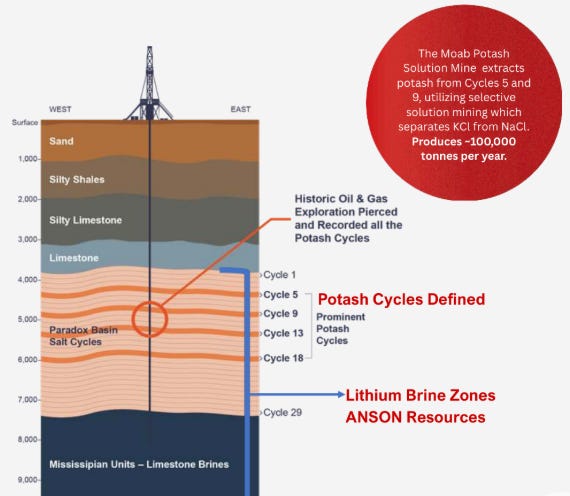
Intrepid Potash (NYSE: IPI) operates its Moab Solution Mine nearby, producing potash from the same Paradox Formation stratigraphy that KCLI is targeting.
That operation has been running for over 50 years.
Stratigraphic continuity across this part of the basin is well established.
Anson Resources (ASX: ASN) has an advanced lithium DLE project contiguous to KCLI’s northern boundary, targeting the same Leadville Formation and Paradox clastic brine zones that underlie KCLI’s entire property.
Anson signed a binding agreement with POSCO Holdings in June 2026 to build and operate a DLE demonstration plant at Green River, with POSCO paying Anson a US$5.2M facilitation fee and taking full responsibility for design, construction, and operation. Demo plant operations are expected to begin in 2027.
On August 5, 2026, Anson disclosed that the Economic Development Corporation of Utah issued a formal Letter of Advice outlining proposed state and local incentive programs valued at approximately US$357.7 million for the Green River Lithium Project.
That includes roughly US$127.75M in post-performance state tax reimbursements, US$229.9M from the Utah Inland Port Authority, and workforce training subsidies. Final approval is expected in September 2026.
The geological thesis has already been partially de-risked by someone else’s money.
The team that’s drilling it:
The leadership transition in April 2026 brought in Dean Pekeski as CEO and President.
Pekeski spent 17 years in potash exploration and development, including seven years as EVP of Western Potash Corp. where he led the discovery and development of the Milestone Potash Solution Mining Project in Saskatchewan, now 80% complete.
He has raised over US$120M in capital across his career. Critically, he has direct experience applying for US government funding from USDA and the Export-Import Bank.
Chairman Simon Clarke, who had served as CEO since September 2024, has been focused on critical minerals development for over 10 years, including serving as CEO of American Lithium leading it to a valuation of over $1 billion.
At the GIGA USA 2026 conference in Washington in June, Clarke and Pekeski presented alongside director Eric Miller, whose DC-based Rideau Potomac Strategy Group advises mining companies on government affairs and critical minerals policy.
Both potash and lithium were added to the USGS Critical Minerals list in 2025. The US imports over 90% of its potash.
This is a team assembled specifically for this moment.
The drill program:
Core recovery through the potash horizons will determine grade and thickness. Core goes to the SRC Laboratory in Saskatoon for specialized potash analysis, with detailed logging and prep at RESPEC’s facility in Rapid City.
Brine sampling follows well completion and wireline logging, with geochemical analysis at ACZ Laboratories in Steamboat Springs, Colorado.
The well is expected to take approximately 35 days to complete. That puts well completion around mid-September. Assay results will follow based on lab turnaround times.
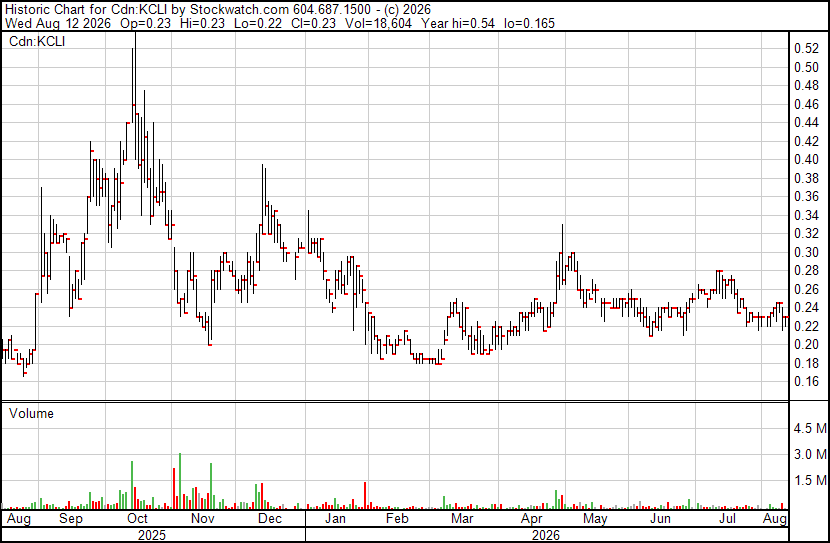
At $0.23 per share with 90.5 million shares outstanding, the market cap is roughly $20.8 million.
Actionable intel:
This is a company that spent a decade assembling land, fighting through permitting, and waiting on federal bonding while the market paid zero attention.
That dead period is over.
The risk/reward math at this stage is straightforward.
The 33 historic well logs and the geology next door all point in the same direction.
If KCLI’s first hole confirms what the existing data already shows, this is not a $20M company anymore.
If the confirmation data holds up, the path forward is clear: mobilize a second rig, expand the drill program across the 7 authorized well locations, build toward a maiden mineral resource estimate, and enter the institutional conversation for the first time.
The window between rig mobilization and assay results is historically the cheapest point on the curve for companies with this kind of pre-existing geological confidence.
Once results hit the tape, the price discovery happens fast.
IMPORTANT DISCLAIMER AND RISK DISCLOSURE
This analysis is provided for informational and educational purposes only and does not constitute investment advice, financial advice, trading advice, or a recommendation to buy, sell, or hold any securities. The author is not a licensed financial advisor, investment advisor, broker-dealer, or registered investment advisor and does not provide personalized investment advice or recommendations tailored to any individual’s financial situation.
All information presented is the author’s opinion based on publicly available information and should not be relied upon as the sole basis for any investment decision. Readers should conduct their own due diligence, research, and analysis before making any investment decisions and should consult with qualified, licensed financial professionals before investing.
Junior mining and exploration stocks carry substantial risks, including but not limited to: potential total loss of investment, extreme price volatility, liquidity risk, operational risks, regulatory changes, commodity price fluctuations, exploration failures, and dilution from future financings. These investments are speculative in nature and may not be suitable for all investors.
The author may hold positions in securities mentioned and may buy or sell such positions at any time without notice. Past performance does not guarantee future results.
Forward-looking statements and projections are inherently uncertain and subject to numerous risks and uncertainties. Actual results may differ materially from any projections or expectations expressed herein.
This content is not intended for distribution to, or use by, any person in any jurisdiction where such distribution or use would be contrary to local law or regulation. By reading this analysis, you acknowledge that you understand and accept these risks and limitations.
If the confirmation data holds up, the path forward is clear: mobilize a second rig, expand the drill program across the 7 authorized well locations, build toward a maiden mineral resource estimate, and enter the institutional conversation for the first time. That sequence is what turns a $20M explorer into something materially larger.
The window between rig mobilization and assay results is historically the cheapest point on the curve for companies with this kind of pre-existing geological confidence. Once results hit the tape, the price discovery happens fast.
I wish you had included somewhere in your article that shares on both US and Canadian exchanges are thinly traded. In the US today 87,000 shares at @ USD $00.23 a share changed hands, meaning total dollar volume of less than $20,000. I'm a new subscriber, so excuse my ignorance, but your article left me wanting a NOTE or CAUTION to put in only limit order bids. We'll see if the US or Cdn shares rocket higher tomorrow, but my vote goes to the author who includes these sorts of warnings, which can only benefit paid subscribers, and even if subscribers ignore such advise, it never hurts to try to educate them about such matters. IMHO.